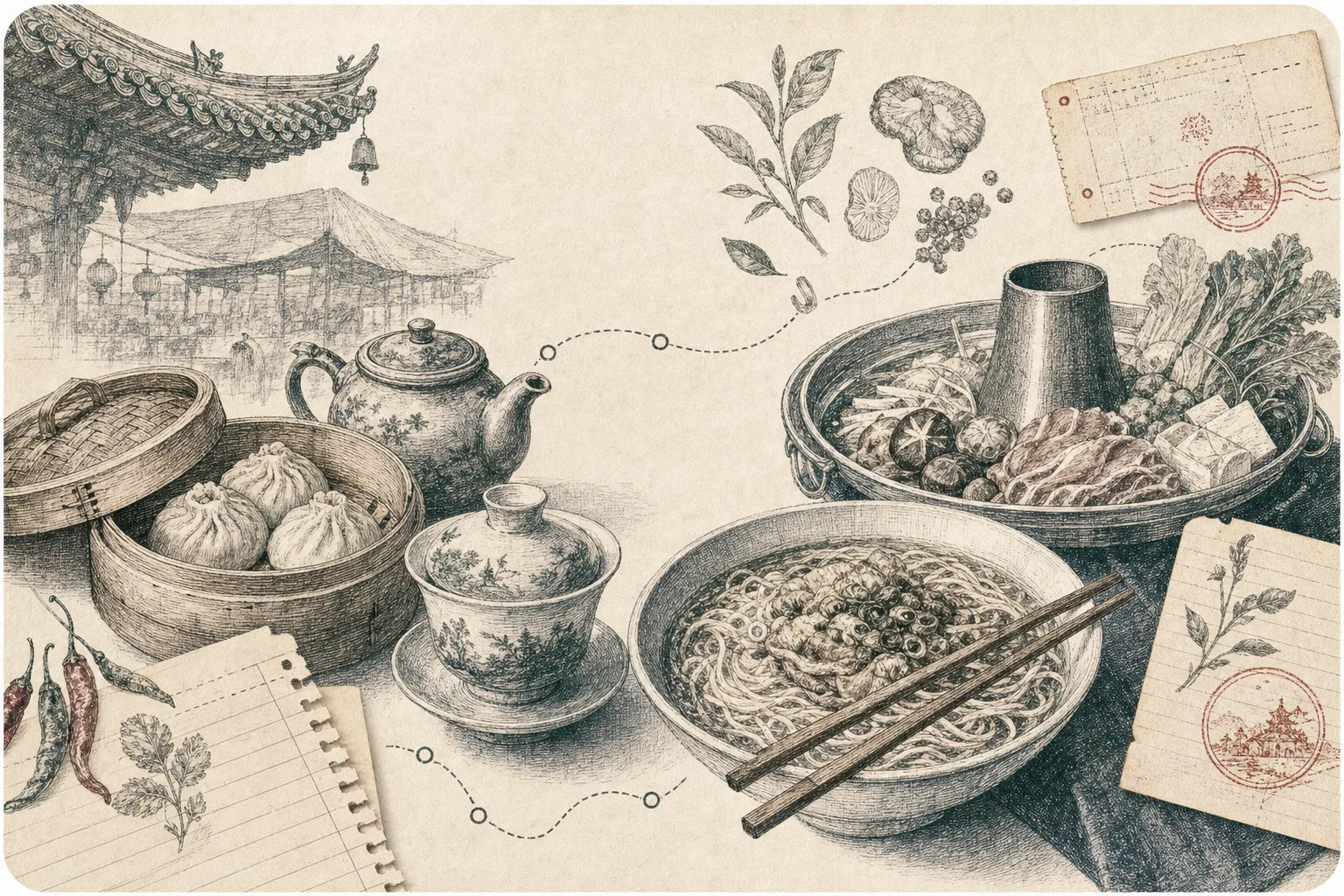
Guangzhou is a trading metropolis whose history appears in food, temples, clan halls, arcaded streets, colonial-era Shamian, modern civic architecture, and communities connected to markets across the world. Its humid climate and large scale reward a route built from compact districts rather than isolated landmarks.
Three days provide a useful introduction: one for older central neighborhoods, one for museums and contemporary Guangzhou, and one flexible day for food, markets, or a regional interest. Evenings by the Pearl River give the trip a natural rhythm without requiring a formal cruise.
- Suggested stay
- Three full days
- Food rhythm
- Dim sum morning, lighter midday, shared dinner
- Urban strategy
- Metro between districts, walking within each cluster
- Weather
- Plan around heat, humidity, heavy rain, and tropical cyclone alerts
Divide the city into historical layers
For an older-city day, group Chen Clan Ancestral Hall with selected Liwan streets, a market or food stop, and perhaps Shamian if energy permits. These places represent different periods and communities; they should not be blended into a single nostalgic version of old Canton.
On another day, move east toward major museums, civic spaces, and modern architecture around Zhujiang New Town. Seeing both scales helps explain Guangzhou as a city that has repeatedly reoriented around trade, industry, infrastructure, and new development.
Eat with a plan flexible enough for appetite
Dim sum works naturally in the morning or around lunch and is easiest with several people sharing. Mark dietary restrictions in Chinese, ask about tea charges and portion size, and order in rounds. Steamers arrive when ready, so a meal does not always follow a fixed course sequence.
Later meals might explore roast meats, soups, clay-pot dishes, seafood, or regional specialties, but no one restaurant represents Cantonese cuisine. Choose licensed, busy places near your route and avoid crossing the city solely because a venue became famous online.
Read arcades and clan architecture
Qilou arcades respond to commerce and climate, creating sheltered street edges beneath mixed-use buildings. Walk a manageable section and notice how older façades, signs, workshops, homes, and redevelopment coexist. Many interiors remain private or commercial rather than heritage attractions.
Clan halls and temples use carving, ceramics, sculpture, courtyards, and ritual space differently. Visit an officially open example with interpretation, behave respectfully where worship continues, and avoid touching decoration even when details invite close inspection.
Use museums to expand the port story
A municipal, provincial, maritime, or archaeological museum can connect Guangzhou to the Nanyue period, the Maritime Silk Roads, overseas trade, and modern transformation. Check reservations and weekly closures, then select galleries relevant to the neighborhoods you are walking.
Museums also provide crucial midday relief in summer. Give them enough time to be more than air-conditioned pauses, but do not schedule two enormous collections back to back. One deep visit is more memorable.
Spend an evening with the Pearl River
Riverside promenades and bridges offer changing views of historic and modern Guangzhou after dark. Choose one stretch linked conveniently to your dinner and metro route. Lighting schedules, construction, and access can change, but a public walk needs less advance commitment than a cruise.
If you want a cruise, use an authorized operator and confirm the pier, route, duration, and weather policy. Different docks are not interchangeable. In storms or strong wind, follow suspension notices and keep the evening on land.
Travel comfortably in a subtropical city
Carry water, take long midday breaks, and use the metro for distances that look walkable only on a small map. Sudden heavy rain can flood low spots and slow road transport. Follow city and meteorological alerts, especially during tropical cyclone season.
Guangzhou's transit and payment systems evolve, so confirm current visitor options through official services. Keep your hotel address in Chinese and leave ample time for the airport or Guangzhou South station, both of which involve large terminals and long internal walks.
Notebook check
- Group food stops around the district you are already exploring.
- Use one museum as the historical anchor for a day.
- Choose a river walk near a direct metro route home.
The useful takeaway
Guangzhou opens through linked experiences: breakfast as food culture, old streets as working architecture, museums as historical context, and the Pearl River as an evening thread. Keep each day geographically compact and the city feels generous rather than overwhelming.